


Empty shelves and a diseased imagination
It was the first lecture of the semester. After dispensing with all the usual questions about assignments, textbooks, and “will this be in the exam”, the rather bemused third-year class found themselves being marched down to the seminary library.
“Choose any section of shelf in the Biblical Studies or Theology section,” I told them.
This is the shelf they chose.
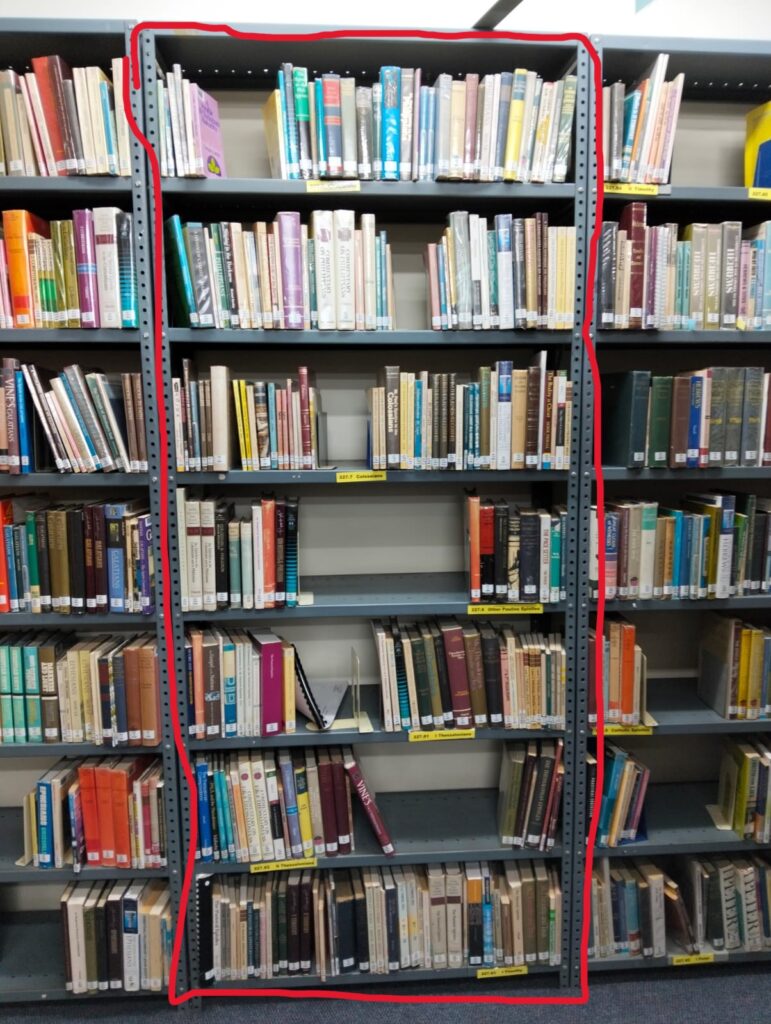
“Now,” I instructed, “remove from this shelf all books written by white men.”
Five minutes later…

When we were finished, we just stood in silence and stared at the near-empty shelves
This was all that was left…
4 books!
One book written by a white woman and two copies of the same book co-written by a white woman and a white man. Only one book was written by an African man. In fact, only one book was written by any person of colour!
Even I had not expected it to look quite so stark.
Perhaps other shelves might have fared better, but it was still difficult to deny the reality of the empty shelves before us. And this is at a seminary that is painfully aware of these dynamics and at which the student body is less than 10% white students. I can only imagine what other seminary libraries might look like.
As I stood looking at those empty shelves, my mind was drawn to the words of Willie James Jennings that “Christianity in the Western world lives and moves within a diseased social imagination… woven into processes of colonial dominance.” [1]
Those bare shelves are a damning symptom of that diseased social imagination. A form of theological colonisation that has embedded (often) unspoken hierarchies of power and worth throughout global Christianity. Indigenous and contextual theological reflection and methodologies are regarded as, at best, inferior and more likely theologically and intellectually suspect. Western theology is regarded as not merely superior but as “normal” or orthodox.
The late Ecuadorian theologian Rene Padilla once said, during a graduate seminar at the University of Cape Town, that “the Church in Latin America is a church without a theology…” [2] By this, he did not mean that there was no theology present (theology is always present, whether acknowledged or not) but rather that there was little to none theological reflection that was specific to the Latin American context. Theology Padilla would later say, “cannot be reduced to the repetition of doctrinal formulations borrowed from other latitudes. To be valid and appropriate, it must reflect the merging of the horizons of the historical situation and the horizons of the text. It will be relevant to the extent that it is expressed in symbols and thought forms which are part of the culture to which it is addressed, and to the extent that it responds to the questions and concerns which are raised in that context.” [3]
In fairness, there has been some improvement in the last forty or so years, but if the empty seminary shelves are not enough for you to recognise the enduring validity of Padilla’s statement, not just Latin America but most of the Majority World, then perhaps you ought to ask yourself:
- Who produces most theological resources available in the Majority World contexts? What languages are they written in?
- Where are those resources produced? Or put another way which context does their theology address?
- Do our churches still, unthinkingly, reflect the theological emphases and cultural patterns of the Western missions and their sending churches that established or exported them?
- Does the preaching in our churches engage with our historical and contextual realities, or are they “limited to a mere repetition of poorly assimilated doctrinal formulae, with no application to our own historical reality” (Padilla, 1978: 21)?
- Who runs our theological seminaries and training institutions? And who is on the faculty? Or perhaps more significantly, who is not on the faculty? Who determines the curriculum that is taught? Does it differ substantially from a similar seminary in, say, London or Chicago?
References
[1] Jennings WJ 2010. The Christian Imagination: Theology and the Origins of Race. Yale University Press: New Haven. p6,9. Social Imagination is, for Jennings, “an imaginative capacity to redefine the social, to claim, to embrace, to join, to desire.” (6)
[2] Padilla CR 1978. The Contextualization of the Gospel. In: Journal of Theology for Southern Africa 24: 12-30, September, p. 20.
[3] Padilla, C. R. 1980. Hermeneutics and Culture: A Theological Perspective. In Stott, J.R.W. & Coote, R. (eds.) Down to Earth: Studies in Christianity and Culture. Grand Rapids: William B. Eerdmans Publishing Company p73.
Photo by Suzy Hazelwood from Pexels.